Knowing others is wisdom;
Knowing the self is enlightenment.
Mastering others requires force;
Mastering the self needs strength.

He who knows he has enough is rich.
Perseverance is a sign of willpower.
He who stays where he is endures.
To die but not to perish is to be eternally present.

-Translation by Gia-Fu Feng and Jane English
I’m reminded of a passage from Epictetus. To paraphrase, “You may not be owned by someone else like a slave is, but if you still spend your time chasing after things you desire, you are as good as a slave to whoever holds the key to what you desire.”
People strive for knowledge of and mastery over external things so they can lead a good life, but any life built without knowledge of and mastery over the self is as good as an edifice built on sand.
Being “rich” has always been relative. Previously, people who owned a washing machine were considered rich; nowadays, even poor families have one. Being rich means having everything you could ever want, or at least having the money to buy it; if you don’t have any extravagant wants, you can be rich even having just the barest necessities.
Do you think you can take over the universe and improve it?
I do not believe it can be done.

The universe is sacred.
You cannot improve it.
If you try to change it, you will ruin it.
If you try to hold it, you will lose it.

So sometimes things are ahead and sometimes they are behind;
Sometimes breathing is hard, sometimes it comes easily;
Sometimes there is strength and sometimes weakness;
Sometimes one is up and sometimes down.

Therefore the sage avoids extremes, excesses, and complacency.

-Translation by Gia-Fu Feng and Jane English
The Taoist sage does not try to forcefully improve the world. The world is beyond anyone’s control and understanding. People can’t even control themselves, don’t even know themselves, so how could they hope to control the world? It simply can’t be done.
Far better to let the world take care of itself, as it has always done.
People sometimes say that some piece of art (“art” in the broad sense, including the likes of movies, books, vidogames, music, etc.) is good, but they don’t like it, or that it’s bad, but they still like it. Statements such as these try to draw a distinction between an objective and subjective evaluation of art. But to what degree does such a distinction make sense? What metric could there possibly be for an objective evaluation of art?
Usually when we say something is a good or bad X, we’re judging how well it fulfills the purpose that an X is supposed to fulfill. For instance, a chair is supposed to be sat on, so if it’s too narrow to sit on or if it’s so weak that it breaks when sat on, it’s a bad chair. Is this also what we mean when we say that a piece of art is good? That it fulfills its purpose? If so, what could the purpose of art be?
One possibility that occurs to me is that the purpose of art is to evoke some emotion, experience and/or idea in its audience. Of course, art is sometimes made for the purpose of making money, but this is purely incidental to art itself, just as making chairs to make money by selling them is distinct from the purpose of the chair itself, which is the reason why people actually buy the chairs.
Now, not all emotions, experiences or ideas are granted the same degree of significance when judging a piece of art. A blockbuster action movie and a war drama both aim to evoke certain emotions, experiences and ideas, and they may both succeed at it, but the latter is more likely to be hailed as a work of art. This means that we think art is supposed to evoke a certain type of emotion/experience/idea. An exact description of this type of experience is beyond the scope of this article, but I think it can roughly be summed up by the word “beauty”.
So, if the purpose of art is to evoke an emotion/experience/idea which has the quality of beauty, then an art piece is objectively good when it manages to do so, and objectively bad when it fails. However, beauty is itself judged subjectively, so this isn’t a truly objective metric by which to evaluate art.
At the same time, even if beauty is subjective, many qualities are almost universally deemed to be beautiful by us humans, or by specific populations of humanity, while others are almost universally deemed to be ugly. The near-universal nature of how we judge these qualities could give the impression that they’re truly objective, and I think they are what judgements of “objective” quality appeal to. That is, people say an art piece is objectively good when it has qualities that are widely-held to denote beauty, and it is objectively bad when it has qualities that are widely-held to denote ugliness.
Of course, this isn’t truly objective because it’s perfectly possible that some alien species with radically different tastes from ours could find beautiful much of what we consider ugly; art that is bad to us would be good to them and vice versa, so its quality still wouldn’t be objective. Still, as long as it’s understood that this is what is meant by calling art “good”, I think it’s perfectly valid to make such claims.
In Thus Spoke Zarathustra, Nietzsche presents the idea of the Three Metamorphoses. He describes a transformation of a spirit into a camel, which strives to live by the set of values it has been given, until it grows overburdened with these values that are foreign to it and seeks to get rid of them. The camel then becomes a lion, which seeks to destroy all values and fight off all attempts to impose any values on it. Finally, the lion becomes a child who, unburdened by the values of others, is able to express themselves through their own values.
Recently, in my study of Taoism, I have come to relate this metaphor to steps that some people might follow on the path towards Taoist sagedom. By accepting everything as equally meaningless, one can become free of the impulses that drive one to chase after or to try to avoid things. The only reason left to do anything is because one truly wants to do it, and this realization was something I feel brought me closer to the Tao.
Nonetheless, this path can be dangerous. People can fall into depression or remain stuck in nihilism if they fail to find a way through.
Some people come to think that the nihilistic idea that everything is meaningless is the only meaningful idea there is, which is a paradox. Someone who really believes that everything is meaningless would also believe that “everything is meaningless” is meaningless. To cling to the idea of meaninglessness, idolize it, and make a whole philosophy out of it, is as if only half of Nietzsche’s camel went ahead with the metamorphosis into a lion, while the other half remained that of a camel.
If someone who claims to believe that nothing matters makes a big deal about the belief that nothing matters, then there must be something that does matter to them–usually some abstract concept like truth, progress, or reason. They’ll often start thinking of themselves as being smarter or braver than other people for having rejected their previous beliefs and accepted nihilism, which is just using nihilism to feed their own egos. If you say everything is meaningless, then it shouldn’t matter to you whether someone is a nihilist, a Christian, a Marxist, or anything else–all beliefs would be equally valid.
I’ve been reading some Epictetus recently and noticed some points of similarity and dissimilarity between Taoism and Stoicism, so I figured I’d say a little about them here.
The main points of similarity seem to come from the shared ideal of the sage as someone who’s actions are in perfect accord with nature. For both traditions, this means knowing what can and what cannot be changed and learning to accept misfortune and not be led around by desire. These are the things pretty much everyone points to when talking about the similarities between the two.
Likewise, the main points of difference are due to having different ideas about what nature is. To use the language of Taoism, you could say that Stoicism focuses on the Yang principle in nature while Taoism focuses on the Yin principle.
For the Stoics, nature is a creation of the Father–Zeus, Jupiter, God–made according to a divine plan which was elaborated according to reason, which is held to be the highest faculty of mankind. As such, the Stoic sage is one who makes use of his reason to discover the proper order of things and determine which things are according to nature, which are indifferents, and which are good; the sage then molds himself according to these principles he’s discovered so his actions may be in perfect accord with nature.
The Taoists, on the other hand, see nature as something that is nourished by and springs from the Tao–also called the valley spirit or great Mother in the TTC–as a tree springs from the earth. The Tao doesn’t strive and doesn’t discriminate between good and bad or right and wrong the way humans learn to do. The Taoist sage, then, is one who has “unlearned” all such distinctions and returned to the simple or “uncarved” state of mind. Once this is accomplished, they effortlessly act in accordance with nature.
So, while there are definitely some similarities between the two, there are also disagreements springing from the different metaphysical beliefs of each school of thought. At the end of the day, both perspectives are valid, but I find the Taoist perspective resonates more with me.
He who stands on tiptoe is not steady.
He who strides cannot maintain the pace.
He who makes a show is not enlightened.
He who is self-righteous is not respected.
He who boasts achieves nothing.
He who brags will not endure.
According to followers of the Tao, “These are extra food and unnecessary luggage.”
They do not bring happiness.
therefore followers of the Tao avoid them.

-Translation by Gia-Fu Feng and Jane English
Sometimes we try to make a big show about how good we are at something. We puff ourselves up to make others respect us. This is done because we feel insecure about ourselves, like how animals try to make themselves look bigger than they really are when they feel threatened. “Look how big and strong I am,” they try to say. “You’d better not mess with me.”
Had you done something praiseworthy there would be no need to boast; your actions would speak for themselves. Had you walked instead of run you would not have tired yourself out. Had you been satisfied with enough food to sate your hunger rather than gorging yourself until you were about to burst you would not have felt ill after eating.
In my post on David Benatar’s antinatalism, I wrote in passing about the concept of nonexistent people. I’d like to expand upon it here.
Nonexistence is something we have a lot of trouble talking about because we know absolutely nothing about it. All we have ever known is existence, so when it comes to nonexistence we can only approach the concept by analogy with things that we can conceive of but which do not currently exist. These approximate nonexistence closely enough for us to be able to say a few things about it, but even so they don’t tell us anything about what nonexistence, if it even “exists”, might look like from the inside.
This is something that has to be kept in mind when trying to talk about nonexistence or nonexistent things, as Benatar did. Though we may have ideas about what nonexistence might “be like,” these aren’t nonexistence itself. For instance, in an attempt to imagine nonexistence we might picture an empty void whose inhabitants have no experiences whatsoever, as if suck in a dreamless sleep. We might also imagine how we would feel if we found ourselves in such a situation. None of this would be nonexistence, however, for even an empty void is still a thing that exists, and if we didn’t exist we wouldn’t have any feelings about “being” in one.
Really, since any attempt at picturing or conceptualizing nonexistence runs into the same problems, I would argue that nonexistence is utterly inconceivable. The only thing we “know” about nonexistence is that everything existence is, nonexistence is not, but we are no more capable of knowing what this means that we would be of knowing what white looks like if we had only ever known black. If I am correct about this, then it’s best to just remain silent about nonexistence.
Often when arguing about some hotly contested issue, people will accuse those on the other side of the debate of being irrational. Sometimes this is because the other side really is being distinctly irrational, but sometimes people on both sides are being equally rational (or irrational). In these cases, accusations of irrationality are born from a lack of intellectual humility.
We all like to think of ourselves as reasonable individuals with reasonable and justified beliefs. Since all our beliefs are rational and justified, the only ways someone else could disagree is if they’re either ignorant or irrational. Sometimes this is the case, but not always, and the assumption that it’s always like this stems from ignorance about a certain limitation of logic.
You see, logic is essentially a system of rules by which you can extract some conclusions from a set of premises; without any premises, you can’t get any conclusions. This means that to be able to make use of logic there have to be some fundamental premises that weren’t obtained through logic. Some of these premises come from observation while others come from intuition, and topic it’s the latter that are most relevant here.
Intuitions can basically be understood as beliefs that we hold because we feel them to be true; not for any other conscious reason. They are foundational to many, if not all, lines of reasoning. In fact, I believe that logic itself might be derived from intuition, since it certainly can’t be derived logically.
Because intuitions can differ between people, and because of their role as premises in our reasoning, it’s perfectly possible for two people with the exact same information and both using flawless logic to arrive at mutually contradictory conclusions because they have different intuitions and thus different sets of premises. Failure to account for this leads to all sorts of lousy arguments, like trying to appeal to your intuitions as evidence that someone else’s intuitions are wrong.
When a difference of opinion is due to a difference of intuitions, it becomes very difficult to argue for your position in a way that will convince anyone. The only way I know to change someone’s intuitions through argument is by pointing out a contradiction in the other person’s intuitions, which can sometimes lead to them reevaluating their beliefs in those things. Even then, our intuitions are some of our most deeply held beliefs, so some people will attempt to reconcile their contradictory intuitions or even remain willfully ignorant of the contradiction rather than give up their intuitions, and if they do give one up, there’s no guarantee it will be the one you want.
For instance, if a person believes in the literal truth of the Bible while also believing that scientists are always right, and you draw attention to contradictions between what the bible says and what scientists say, they can either choose to stop believing that scientists are always right or to stop believing that the Bible is literally true; it all depends on which belief they hold more dearly.
When discussing subjects like these with people, I find it’s best to retain intellectual humility and recognize that your own beliefs may be no more logical than theirs and you just can’t see it yet. Try to present your own beliefs as best you can, but more importantly, try to engage with theirs, if they don’t understand your reasoning try to explain it more clearly, and if they refuse to engage with you then simply leave as no productive discussion can be had.
David Benatar, author of Better Never to Have Been: The Harm of Coming Into Existence, is an antinatalist. He believes that coming into existence is a great harm, and that it would be best if everyone were to stop reproducing so that life could disappear altogether. Benatar’s writings are perhaps the most influential antinatalist texts, and the arguments he presents for his position are accepted and repeated by many other antinatalists.
Over the years I have had many encounters with Benatar’s ideas without ever actually reading his book, and always found his arguments unconvincing. Recently, however, I came across an article by him, titled “Why it is Better Never to Come Into Existence” and published in 1997, in which he presents a more developed form of his arguments than what I’d been exposed to in online forums and articles in which he was interviewed. Having finally got the chance to analyze Benatar’s arguments for antinatalism, I found them all absolutely terrible, so plagued by self-contradictions and fallacious reasoning that I can’t see how anyone could take him seriously.
Granted, it’s perfectly possible that in the 22 years since the article was published Benatar fixed some of the problems found in this article, but having read some more recent articles he’s written has given me no indication of it, and while I still haven’t read his book, “Better Never to Have Been,” this article seems to give a thorough enough description of his philosophy to justify rejecting it definitively, as I will try to show in this post.
The “Non-Existent”
I would first like to draw attention to the phrase “come into existence,” in the title of the article. The phrase suggests that prior to our existence we were somewhere else, since to “come” somewhere implies to “come from” somewhere else. In this case, the only “somewhere else” we could have been in is nonexistence, but this is a paradox since only things that exist can be anywhere, or be at all. To say that we are brought into existence implies that we already existed in nonexistence.
This might seem like I’m just nitpicking Benatar’s choice of words. Maybe he was a bit careless with his words, or maybe he just chose to use the most common way of phrasing the idea despite its philosophical baggage because it would best communicate his meaning–something I find perfectly understandable, and which I’ll also be doing later on in this post–and so we shouldn’t assume that he actually holds this contradictory notion of people “existing” as nonexistent entities.
Indeed, if the only thing that suggested he might actually hold this notion that people can “be” nonexistent were his use of “come into existence” and similar phrases I wouldn’t even be bringing this up here. Unfortunately, this notion is implicit all throughout Benatar’s article.
For instance, in section II he writes: “None of this befalls the non-existent. Only existers suffer harm.” This phrasing implies the existence of a group called “the non-existent,” and that whose who form part of this group are spared of all the harms that befall the living. But nonexistent people don’t exist, thus they can’t be anything, not even part of a group of nonexistent people.
Then there are the times Benatar says things like “better never to come into existence,” or “there are benefits both to existing and non-existing.” These phrases raise the questions: Who is nonexistence better for? Who is benefitted by nonexistence? It can’t be better or beneficial for the nonexistent because there are no nonexistent people; they can’t be better off or benefitted by anything, so what could Benatar mean with these phrases?
Even Benatar himself sees that his language raises this issue and makes an attempt to explain himself:
“Note that when I say that non-existence is ‘better than,’ ‘preferable to’ or ‘has an advantage over’ existence, I am not committed to saying that it is better, preferable, or advantageous for the non-existent. The non-existent are not, and so things cannot literally be better for them or to their advantage. When I say that non-existence is preferable, that judgment is made in terms of the interests of the person who would or has otherwise come to exist. The claim is that for any person (whether possible or actual), the alternative scenario of never existing is better. It is because the evaluation is always made in terms of the person that would (or does) exist (that is, the person in scenario A) that my view is not what has been called ‘impersonalist,’ even though the comparison is with a state of affairs (scenario B) and not with the state of a person.”
So Benatar here disowns both the interpretation that says nonexistence is “better” for the nonexistent and all interpretations that say it’s impersonally better (better without being better for anyone). With this in mind, what possible interpretations are left for his claims that nonexistence is better than existence?
The only alternative which occurs to me is that Benatar is saying that all people who exist or could exist prefer or would prefer nonexistence to existence. This interpretation doesn’t posit that the nonexistent are any better off than “existers”, so it doesn’t fall into the paradox of the first interpretation, and it takes into account the preferences of the person who does or could exist so it’s not impersonalist.
However, this interpretation has to be rejected for two reasons: Firstly, it’s simply false that all, or even most, people find nonexistence preferable to existence, and so it’s not compatible with Benatar’s antinatalism. Secondly, the very next paragraph Benatar writes rejects this interpretation; by calling nonexistence better than existence, he’s trying to say that it’s objectively better, not just preferable or subjectively better, as can be seen in these passages:
“The fact that one enjoys one’s life does not make one’s existence better than non-existence.”
“Even if one cannot be mistaken about whether one currently is glad to have been born, it does not follow that one cannot be mistaken about whether it is better that one came into existence.”
So now that Benatar has implicitly or explicitly rejected every interpretation I could think of, how are we to understand the phrase? Well, of all the interpretations, the one which I think jives best with Benatar’s arguments is the first: that nonexistence is better for the nonexistent. Though Benatar disowned this interpretation, I believe his unconscious continues to hold onto it, and this is why it continues to inform his arguments without him ever realizing it.
Benatar’s Asymmetry
Thus far I haven’t actually addressed any of Benatar’s arguments for antinatalism, so let’s leave aside the question of who is nonexistence better for and address Benatar’s first argument for antinatalism–the asymmetry that’s come to be named after him. Benatar writes:’
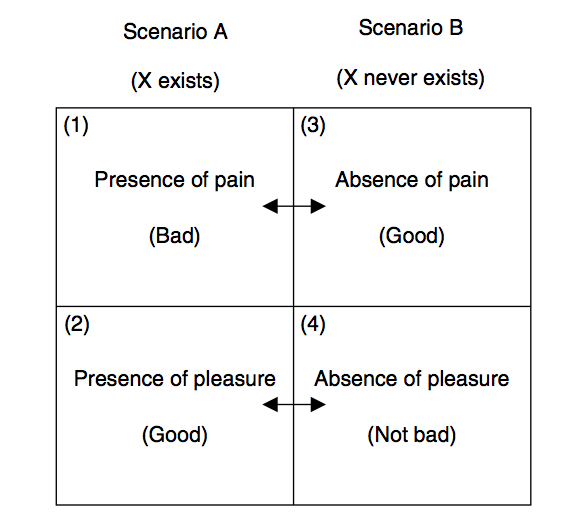
“It is uncontroversial to say that: 1) the presence of pain is bad and that 2) the presence of pleasure is good.
“However, such a symmetrical evaluation does not apply to the absence of pain and pleasure, for: 3) the absence of pain is good, even if that good is not enjoyed by anyone, whereas 4) the absence of pleasure is not bad unless there is somebody for whom this absence is a deprivation.”
To support his asymmetry, Benatar brings up three “commonly-held” moral judgements or intuitions:
A) The view that “while there is a duty to avoid bringing suffering people into existence, there is no duty to bring happy people into being.”
B) That “whereas it seems strange to give as a reason for having a child that the child one has will thereby be benefited, sometimes we do avoid bringing a child into existence because of the potential child’s interests.”
C) That “bringing people into existence as well as failing to bring people into existence can be regretted. However, only bringing people into existence can be regretted for the sake of the person whose existence was contingent on our decision.”
Benatar believes that the underlying reasoning behind these intuitions makes use of his asymmetry. If true, that means that all people who hold these intuitions unconsciously accept this asymmetry.
In order to show the implications of his asymmetry for the question of whether existence or nonexistence is better, Benatar presents this diagram:
According to Benatar, we can ascertain whether or not existence is better than nonexistence by comparing the left side of the diagram with the right side. Since both good and bad things are included in existence, but only good things are included in nonexistence, nonexistence comes out the clear winner in every possible case.
As Benatar writes elsewhere, “One of the implications of my argument is that a life filled with good and containing only the most minute quantity of bad—a life of utter bliss adulterated only by the pain of a single pin-prick—is worse than no life at all.” However, this conclusion contradicts what most people feel about life.
Most people feel their existence is better than nonexistence. Most people also believe that there’s nothing inherently bad about bringing people into existence. This is significant because it means that Benatar’s interpretation of the three intuitions he mentioned goes against other very common intuitions, which suggests that Benatar has misinterpreted his intuitions–that his asymmetry is not the reason why people hold these intuitions.
Even if Benatar’s interpretation is correct, the fact that some of our intuitions support antinatalism while others contradict it means that if he wants to use the former in support of antinatalism, he would first need to argue against the validity of the latter, something which I’ve never seen him do.
A second issue I find in Benatar’s three intuitions is that he’s mischaracterized what people actually believe.
I don’t believe most people agree with intuition A’s claim that “there is a duty to avoid bringing suffering people into existence.” I say this because we don’t react to parents with suffering children the way we react to people who shun their duties. Towards the latter, most people react with contempt, disappointment, anger, or other similar emotions; towards the former, people are more likely to react with pity and empathy.
I also don’t think that most people hold intuition C–that they would feel regret that a suffering person was brought into existence and feel it for the sake of that person. What most people would regret, I believe, is that the person is suffering, not that they were brought into existence.
The only intuition I think is commonly held is B, though I would like to suggest an alternative interpretation as to why people have this intuition.
Upon deciding to have a child, the prospective parents take on certain duties, including the wellbeing and happiness of the child. If the parents believe that the life of the child would not be worth living–that it would suffer from some terrible condition and would come to wish for death–then the parents might choose to preemptively grant the potential child’s wish to not exist.
The reason why the wellbeing or wishes of a potential child can be given as a reason to not have the child, but can’t be given as a reason to have the child, is because only the people who want to have a child take on parental responsibilities regarding the wellbeing of their potential children. Someone who has no intention of having children has no responsibility towards any potential child of theirs as long as they refrain from having children.
If you recall, this is one of the possible interpretations of Benatar’s claim that existence is better than nonexistence–the one where the claim is taken as meaning that the person in question would prefer to not exist. This interpretation is perfectly compatible with the common view that it is better for some people–not all people, as Benatar’s interpretation implies, but some–not to come into existence.
Going back to the asymmetry, Benatar presents two alternative ways of evaluating the absence of pain and of pleasure that try to restore a symmetry and defends his asymmetry against them. He says that, in order to be valid alternatives, they should be compatible with the three intuitions he brought up. I’ve already addressed those intuitions so I’m not going to go any further into this part of his argument. What I do want to comment on is Benatar’s criticism of the second alternative he presents, which claims that:
1) The presence of pain is bad 2) The presence of pleasure is good 3) The absence of pain is not bad 4) The absence of pleasure is not good
I quote here the entirety of Benatar’s criticism of this alternative. (Note that it was originally just one paragraph but is presented here as three for the sake of readability)
“On one interpretation, ‘not bad’ is equivalent to ‘good’ and ‘not good’ is equivalent to ‘bad.’ But this is not the interpretation which is operative in this matrix, for if it were, it would not differ from, and would have the same shortcomings as the previous matrix. ‘Not bad’ means ‘not bad, but not good either.’ This is too weak. Avoiding bringing a suffering child into existence is more than merely ‘not bad.’ It is good.
“Judging the absence of pleasure to be ‘not good’ is also too weak in that it does not say enough. Of course the absence of pleasure is not what we would call good. However, the important question, when the absence of pleasure involves no deprivation for anybody, is whether it is also ‘not bad’ or whether it is ‘bad.’ The answer is that it is ‘not good, but not bad either’ rather than ‘not good, but bad.’ Because ‘not bad’ is a more complete evaluation than ‘not good,’ that is the one I prefer.
“However, even those who wish to stick with ‘not good’ will not thereby succeed in restoring a symmetry. If pain is bad and pleasure is good, but the absence of pain is good and the absence of pleasure not good, then there is no symmetry between pleasure and pain.”
First off, Benatar provides no arguments against the proposition that the absence of pain is neither good nor bad, he just asserts that his evaluation of it as “good” is correct.
He also acts as if there’s a dichotomy between calling the absence of pleasure either “not good” or “not bad”, but “neither good nor bad” is a viable third alternative. “Neither good nor bad” is a more complete evaluation than either “not good” or “not bad”, so it would be preferable by his standards. Also, Benatar’s preferred phrasing of “not bad” is worse than “not good” because it implies that the absence of pleasure can be good.
Finally, in the last sentence quoted, Benatar says that the evaluation of the absence of pain as good and the absence of pleasure as not good doesn’t restore symmetry. This is true, but it’s irrelevant because the alternative he’d criticizing doesn’t claim that the absence of pain is good; it claims that the absence of pain is neither good nor bad, as he himself pointed out at the start of the paragraph and apparently forgot not ten sentences later.
Anyways, after concluding that he’s sufficiently argued against alternatives to his asymmetry, Benatar presents an analogy which is supposed to demonstrate that “For the good to be a real advantage over non-existence, it would have to be the case that its absence were bad.” Here is his analogy:
“S is prone to regular bouts of illness. Fortunately for him, he is also so constituted that he recovers quickly. H lacks the capacity for quick recovery, but he never gets sick. It is bad for S that he gets sick and it is good for him that he recovers quickly. It is good that H never gets sick, but it is not bad that he lacks the capacity to heal speedily. The capacity for quick recovery, although a good for S, is not a real advantage over H. This is because the absence of that capacity is not bad for H (and H is not worse off than he would have been had he had the recuperative powers of S). S is not better off than H in any way, even though S is better off than he himself would have been had he lacked the capacity for rapid recovery.”
However, I don’t believe that this analogy exemplifies what Benatar thinks it does. To show this, let’s first translate the terms “illness” and “recovery” into the language of pain and pleasure which Benatar uses in his asymmetry: Illness is a type of pain while a recovery is a return to the absence of that pain. S can benefit from a capacity for recovery because he has pains to recover from, whereas H can’t benefit from a capacity for recovery because he has no pain to recover from. None of the elements in Benatar’s analogy can be mapped onto pleasure or the absence of pleasure, so his analogy doesn’t show anything about these.
The confusion, I think, lies in Benatar’s equivocation of the terms “good” and “bad” with “pain” and “pleasure”. Notice how these last two terms, which his asymmetry is based on, are wholly absent from his analogy. Notice also that he’s not trying to show that the absence of pleasure is not bad–he’s trying to show that the absence of “the good” is not bad. But this contradicts his own claims that the absence of pleasure (a good) is bad when there is someone being deprived of pleasure–a claim that needs to be true, if his asymmetry is to support antinatalism.
How Great a Harm Existence is
Benatar now turns to a different issue–that of our general quality of life. Benatar believes that our lives are not as good as we think they are. He points out people’s opinions about what constitutes an acceptable quality of life differ, and even the same person might come to hold a different opinion at different times. He also points out that people’s opinion on whether or not they would prefer not to have come into existence can change at different times.
He suggests that this lack of consensus is evidence that people are bad judges of what constitutes an acceptable quality of life and of whether it’s better to exist or not exist. However, this conclusion takes it for granted that there is such a thing as an objectively correct minimum acceptable quality of life and an objectively correct answer to whether existence or nonexistence is better. If one doesn’t already accept these propositions (which Benatar doesn’t argue for), then the fact that opinion on these questions differs can be taken as evidence that these issues are subjective, not objective.
Also, even if we were to accept Benatar’s conclusion that people are bad judges of their quality of life, it doesn’t follow from this that people are overestimating their quality of life. It is just as valid to suggest that people are underestimating their quality of life.
On Death
The last thing I would like to address is Benatar’s comments on death. Benatar believes that all death is a harm, but I can’t see how this opinion can fit with his overall argument that existence is so much worse than nonexistence. He says:
“Whereas pre-conception non-existence or the non-existence of possible people who never become actual is not something which happens to anybody, death (the cessation of existence) is something that happens to somebody. It happens to the person who dies. Whereas Epicurus is correct that where death is, I am not and where I am, death is not, it does not follow that I have no reason to regard my death as a harm. It is, after all, the termination of me and that prospect is something that I can regret intensely.”
However, this argument proves nothing about death itself being a harm. Up until now, the only criteria Benatar has supplied that could determine how harmful, or how bad, something is are pain and the absence of pleasure in the existent. Benatar’s argument here is that the fear of death causes him psychological pain, but this only shows that the fear of death is a harm, not that death itself is harmful. Death itself doesn’t cause any pain and represents, according to Benatar’s arguments, a passing into a state which is far superior to existence.
If death is to be considered harmful, then, it must be by some criteria other than how much pain or pleasure it causes or prevents, but so far as I know, Benatar has suggested no such criteria, neither here nor anywhere else.
Benatar’s claim that death is bad seems more a rationalization of an instinctive fear of death than a conclusion arrived at through application of his arguments for antinatalism–an attempt to cover up a disagreement with his own philosophy, which suggests that he’s already so committed to antinatalism that his response to any apparent contradiction is to rationalize it away so it doesn’t threaten the validity of antinatalism.
Indeed, Benatar’s arguments and reasoning as a whole are more suggestive of someone trying to rationalize an idea they’ve already been seduced by, who won’t be satisfied until they’ve shown that it’s a reasonable idea to have, than of someone honestly trying to follow a line of reasoning wherever it may lead. A harsh judgement, perhaps, but one I feel is justified
Give up being great, forget being clever
And people will benefit enormously.
Give up being kind, forget being just
And love will return to the family.
Give up being sly, forget being greedy
And there’ll be no more thefts or robberies.

Yet as a lesson
These three are incomplete.
The essential part to be added is this:
Become plain and simple
Like uncut wood.
Restrain your ambitions,
Restrict your desires.

-Translation by Agnieszka Solska
Don’t use intellect as a way to achieve what would come to you naturally if you just allowed it. The first verse mentions some ways you might apply this and what you could accomplish with it. The second verse says that these are just superficial examples, and you should seek to practice it your whole life, not just in particular instances.
 Under the Spell of Words